Page in progress of being made, I like chess.
Chess Player Rating Prediction
Built a machine learning classification model to predict chess player skill levels (Beginner, Intermediate, Advanced, Expert) by analyzing approximately 20,000 real online chess matches. Used logistic regression to identify patterns in game characteristics, opening strategies, and match dynamics that correlate with player expertise, achieving 58% accuracy across four rating groups.
Project Overview
This project focuses on predicting a player’s rating group using data from approximately 20,000 real online chess matches. The dataset contains rich information about each game, including player ratings, the number of turns, the opening used, the time control, and the victory status. By analyzing these variables, the goal was to build a model capable of identifying how game characteristics and strategic patterns relate to player skill level.
Feature Engineering & Data Preparation:
Before model development, the dataset underwent several feature engineering steps to improve quality and interpretability. Column names were standardized, and missing or unrealistic entries such as matches under five turns or exceeding 200 were removed. Timestamps were converted into readable date formats, and a new feature called rating_diff was created to capture the rating gap between players. Player ratings were then binned into four groups:
• Beginners: 0–1200
• Intermediates: 1200–1600
• Advanced: 1600–2000
• Experts: 2000+
This transformation allowed the data to be modeled as a classification problem.
Model Development & Results:
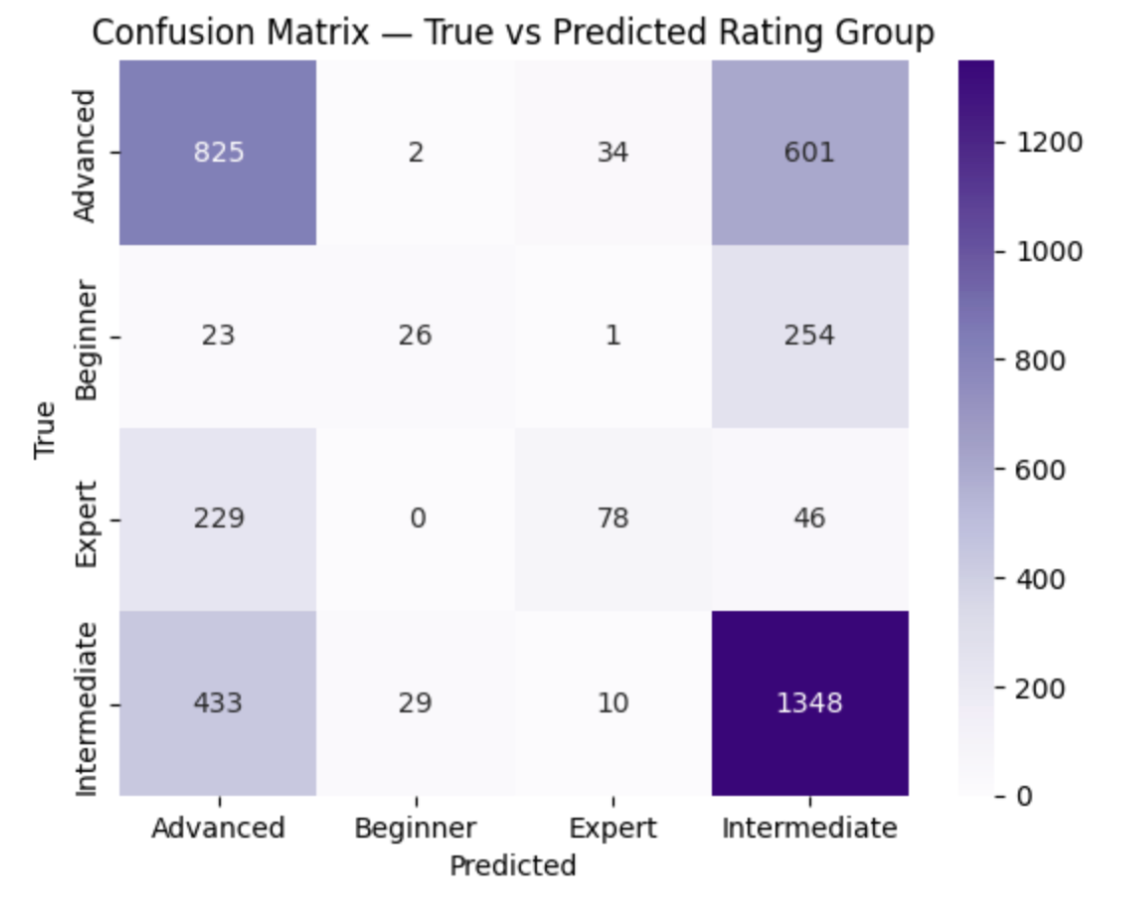
The model was trained using an 80/20 train/test split, stratified by class to preserve rating group proportions. A logistic regression classifier was chosen to balance interpretability with predictive performance. The model achieved an overall accuracy of approximately 58%, which is respectable given the overlapping characteristics between skill groups.
The model performs best at identifying Intermediate and Advanced players, though it struggled slightly with the smaller Beginner and Expert classes due to class imbalance. Chess openings and game length emerged as the strongest predictors of skill, validating the hypothesis that strategic complexity and endurance correlate with player ability.
Dataset Insights
Key Dataset Observations
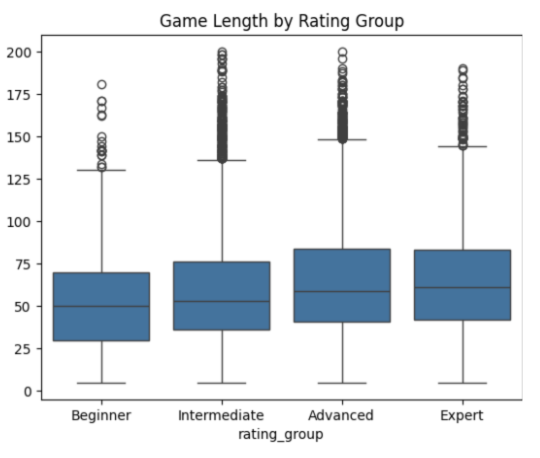
On average, white players had a rating of 1596.6 and black players 1588.8, while the typical game lasted around 60 moves. The most frequently seen openings were Van’t Kruijs, the Sicilian Defense, and the Bowdler Attack, with resignation being the most common method of victory. The majority of players fell into the Intermediate and Advanced groups, showing that most of the sample represented mid-level skill categories. Advanced and Expert players generally played slightly longer games, suggesting more strategic depth, while time control settings were similar across all levels, meaning that game length rather than time setting tends to distinguish player skill.
Distribution & Game Length Analysis
The visualizations below show the distribution of players across rating groups and how game length varies by skill level:
Model Performance: Confusion Matrix
The confusion matrix reveals how well the logistic regression model classified players into their true rating groups:
Key Findings
Chess Openings Matter
Opening choice emerged as one of the strongest predictors of player skill level, indicating that strategic knowledge directly correlates with rating.
Game Length Insights
Game duration and turn count showed clear patterns across skill groups, with experts typically playing longer, more complex games.
58% Accuracy Achieved
Model correctly classified players 58% of the time, performing best on Intermediate and Advanced groups with overlapping behaviors.
Class Imbalance Challenge
Beginner and Expert classes proved harder to classify due to fewer examples, highlighting opportunities for future data collection.
Most Common Chess Openings
Victory Status Distribution
Technical Implementation
Future Improvements
• Collect more data for underrepresented classes (Beginners and Experts)
• Experiment with ensemble methods (Random Forest, XGBoost) for better accuracy
• Add move-by-move analysis to capture tactical patterns
• Incorporate opening theory depth and move quality metrics
• Test regression approach to predict exact rating values
• Implement SMOTE or other techniques to handle class imbalance